

Published: By Trucell7 min read
First look at LG Calibration Studio Medical (LCSM): the cloud calibration platform coming to LG diagnostic display fleets
First look at LG Calibration Studio Medical (LCSM): the cloud calibration and fleet management console for LG diagnostic displays, previewed 20 May 2026.
On 20 May 2026, Trucell joined LG Medical’s partner preview session for LG Calibration Studio Medical (LCSM), the new cloud-hosted calibration and fleet management platform for LG diagnostic, clinical review, and surgical displays.
LCSM is not yet generally available to customers. The platform is in partner preview today, with customer general availability expected in the months ahead. This article is a write-up of what we saw in the session and what LCSM will change for sites already running LG diagnostic displays, or considering a refresh in 2026, so radiology, biomedical, and IT teams can start planning ahead of LG’s wider rollout.
What LCSM is
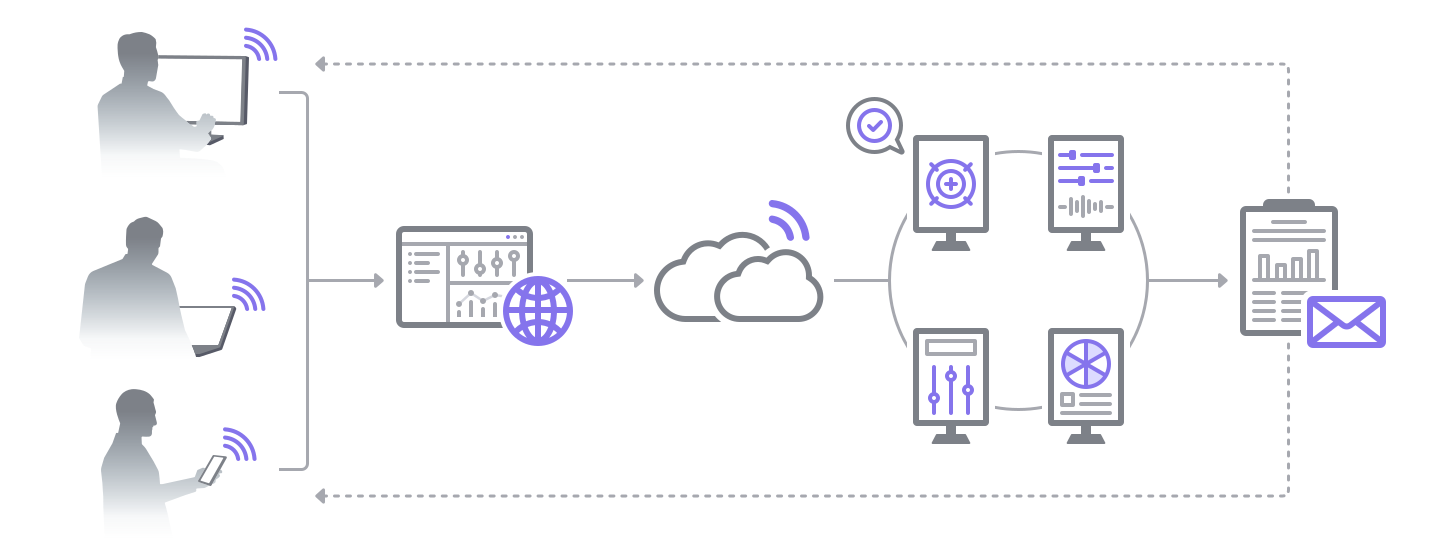
LCSM is a cloud-hosted management console for LG medical displays, reachable from any browser at lcsm.lgbusinesscloud.com. Each enrolled workstation runs a lightweight LCS Agent that drives the display’s internal calibration sensor and reports state back to the LCS Cloud. Each enrolled monitor is visible from a single console regardless of which campus, reading room, or operating theatre it sits in, and the same console covers scheduling, calibration history, firmware state, and warranty tracking.
For radiology IT or biomedical engineering, the practical change is that the management console is reachable from any supported browser via session-based access, rather than being a separately installed application that has to live somewhere on each site’s network. The LCS Agent still needs to be deployed on each workstation that drives a display (it is what actually exercises the display’s internal calibration sensor on the schedule LG specifies), but it now reports out to the LCS Cloud.
What we saw in the preview session
LG has organised the platform around five feature areas (Automation, Cloud Solution, Real-time Monitoring, Remote Calibration, and Visualization), and the session walked through each in turn. Five things stood out as practical changes for the people who actually run a diagnostic display fleet.
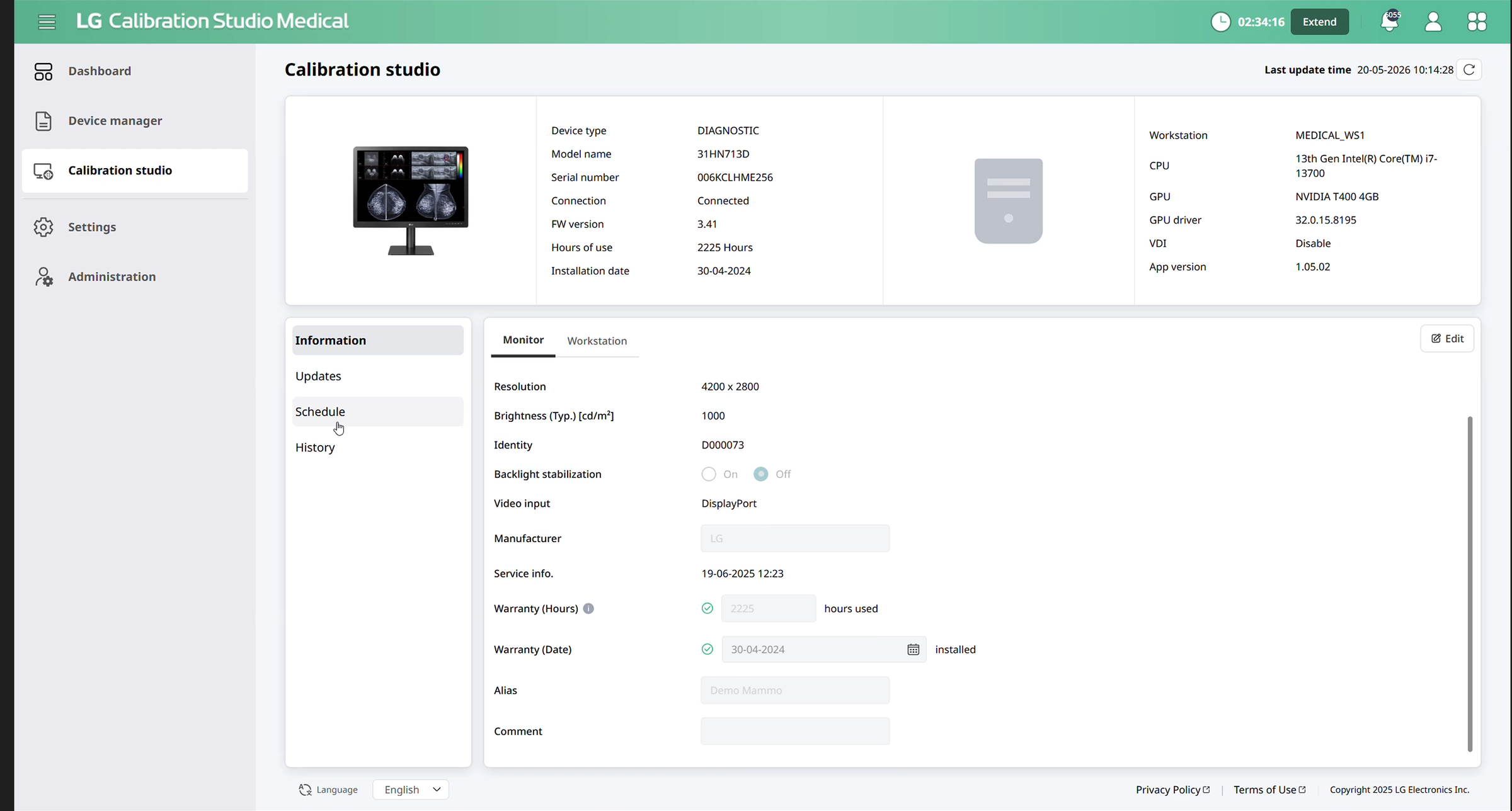
Per-device detail in one place. Each enrolled monitor surfaces device type (diagnostic, clinical review, surgical), model, serial number, firmware version, hours of use, installation date, and live connection state. Workstation context sits alongside it: CPU, GPU model, GPU driver version, VDI status, and the LCSM app version on the host. This is the device monitoring and real-time monitoring surface in LG’s terms.
Monitor settings exposed from the console. Resolution, typical peak brightness, video input, backlight stabilisation, and a human-readable alias (the demo unit in the session was tagged “Demo Mammo”) are visible and controllable per device, rather than something a technician sets locally at the panel. This is LG’s remote calibration and user-friendly management surface.
Warranty tracking at a glance. Each device shows warranty in two views: hours used against the lifetime limit, and warranty start date against the elapsed period. Both surface a pass indicator when the device is still covered. Operationally this is useful for refresh planning, because warranty status across the whole fleet becomes a list view rather than a spreadsheet someone maintains by hand.
Scheduling and history as first-class views. Each device has its own Information, Updates, Schedule, and History tabs. A biomedical engineer can see exactly when the next calibration is due, what the last cycle measured, and the full audit history without leaving the console. This is the automation and calibration result management surface.
Group, location, and device-type based management. LG demonstrated batch management by group, location, and device type, so a multi-site network can apply a calibration schedule to “all mammography displays at Site A” or “all surgical displays across the network” without configuring each device individually.
What stays the same
The calibration model underneath LCSM is the same model existing LG customers already know.
- Built-in sensor self-calibration. Each diagnostic monitor calibrates against its internal sensor. No external puck per display, no manual probe round.
- DICOM Part 14 (GSDF) tracking. Calibration cycles target the standard greyscale display function that radiology accreditation expects, with mammography reading calibrated to the higher 1000 cd/m² luminance bracket where applicable.
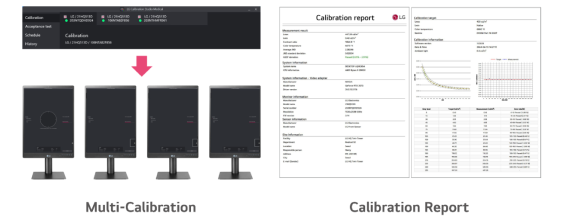
- Scheduled automatic calibrations. Cycles run on a managed cadence across the fleet rather than requiring a technician visit per room.
- Centralised reporting and audit trail. Calibration results are exportable for the QA file, which is what accreditation reviewers ask to see.
- Multi-site fleet management. A single console covers all enrolled monitors regardless of campus.
What this changes operationally
The shift to a cloud-hosted console removes the network-reachability problem of the previous operating model. The LCS Agent still sits on each workstation, because the agent is what actually exercises the display’s internal calibration sensor on the schedule LG specifies. What changes is that the agent now reports to a single LCS Cloud rather than to a console an engineer had to be on-network to reach. For a multi-campus hospital network, or a radiology group with rooms in several suburbs, that change means the same biomedical or IT engineer can supervise the whole fleet from any browser.
The other meaningful change is visibility. Hours of use, warranty status, firmware version, and last calibration date become a list view across the entire fleet rather than something an engineer pieces together per room. That supports refresh planning, accreditation evidence, and incident response in the same place.
We have written before about how the operating model around the display, not the panel spec, is where vendors meaningfully differ in 2026 (see How Alfred Health switched from EIZO to LG diagnostic displays). LCSM is the next step along that direction of travel, although it remains in partner preview today.
Who LCSM is for, when it ships
Three groups should pay attention to LCSM and start planning ahead of general availability.
- Existing LG diagnostic display fleets. Onboarding existing monitors into LCSM will be the first step once the platform ships. Trucell can scope and run the enrolment with your biomedical and IT teams when the time comes.
- Multi-site networks. Hospital networks and radiology groups with displays across multiple campuses will get the largest workflow benefit from the cloud console, because the management surface is reachable from any browser without per-site network setup. The LCS Agent still needs to be deployed on each workstation that drives a display, but cross-fleet visibility (calibration status, warranty, firmware, hours of use) converges in one place.
- Sites planning a 2026 refresh. If you are weighing LG diagnostic displays for a refresh this year, LCSM is part of the operating model you would be buying into. That is true whether you are running a structured evaluation against an incumbent platform, or moving an existing fleet to current generation hardware via the NSW Health Standing Offer HSSP HC22 AME885 procurement path.
What this means for Trucell customers
LCSM is not yet available to customers. When LG makes it generally available in the months ahead, Trucell will be ready to support LG display customers across Australia, New Zealand, Chile, and the Philippines. Practically, that means three things:
- We will help existing LG diagnostic display sites onboard into LCSM and verify scheduled calibration is running cleanly across the fleet from day one of customer availability.
- We will scope LCSM into new proposals for diagnostic, clinical review, and surgical display deployments, so the operating model is clear before a quote is signed off.
- We will continue to support governed procurement paths for the underlying displays (including the NSW Health Standing Offer where it applies), with LCSM as the platform behind them once generally available.
If your displays are still on the older operating model, our free DICOM monitor brightness test kit is the lightest-weight way to check where your fleet sits today, before deciding whether a refresh, a recalibration, or a future LCSM onboarding is the right next step.
Talk to us
If you run LG diagnostic, clinical review, or surgical displays today, or you are evaluating a refresh in 2026, we can scope what onboarding into LCSM will look like for your sites once the platform ships. Use the form below to register interest and start the conversation.
Images in this article are courtesy of LG and are sourced from LG Business Cloud.
Related reading
- How Alfred Health switched from EIZO to LG diagnostic displays, and what tipped the decision
- Lunch and Learn: LG diagnostic monitors and digital X-ray detectors at Westmead Hospital
- How to check if your radiology display is still meeting brightness standards (free test kit)
- Trucell awarded NSW Health SOA HSSP_HC22_AME885 for Ancillary Medical Imaging Equipment