

Trucell provides accountable IT operations for organisations where uptime, governance, security, procurement, and evidence matter. ClariRad RIS is Trucell’s radiology information system for organisations that want bookings, reporting, billing-adjacent administration, and referrer workflows on one coherent platform—with integrations to your PACS, modality worklists, orders messaging, and finance stacks scoped explicitly per engagement. Trucell manufactures ClariRad RIS and delivers migration, go-live, hypercare, and ongoing support so imaging operations retain one accountable thread through governance reviews and day-two incidents.
From desk to exam
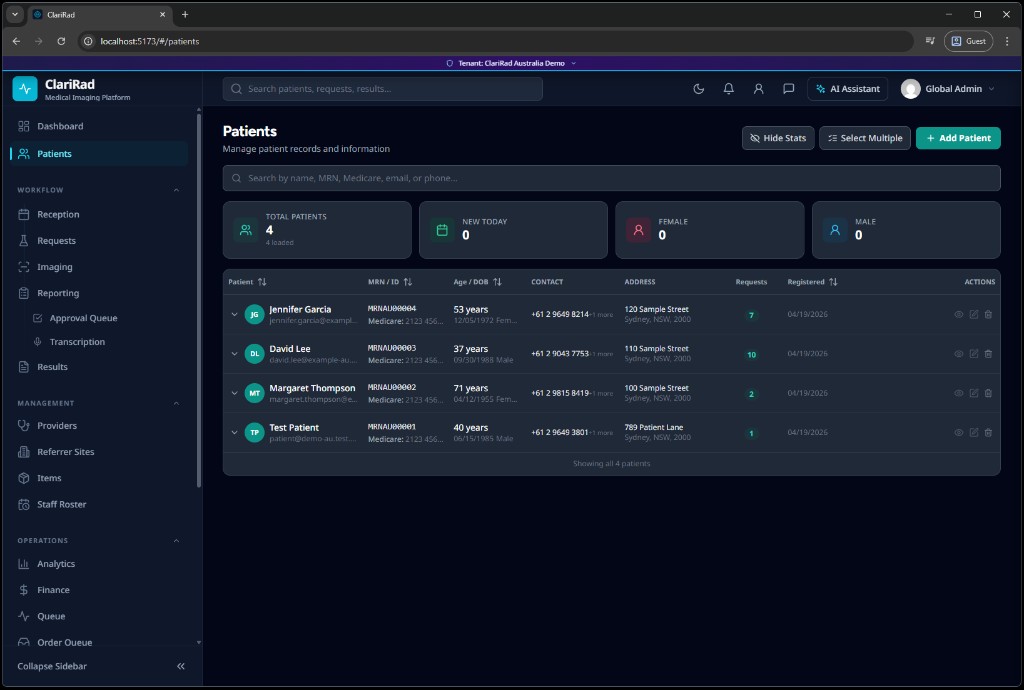
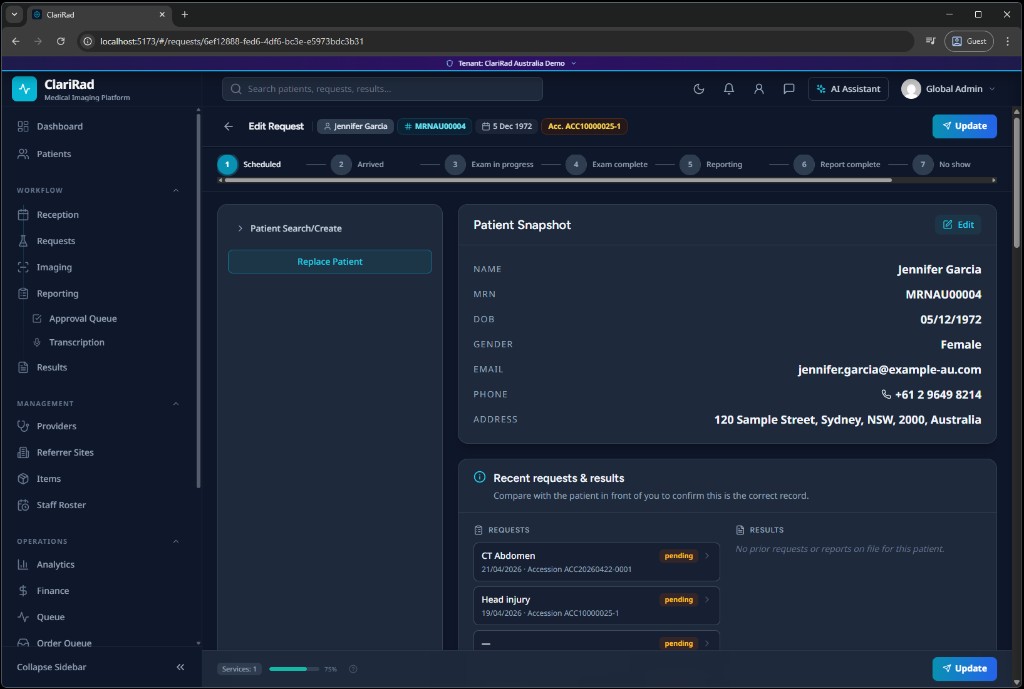
Workflow problems ClariRad RIS is built to address
Many imaging groups still stitch together bookings, reporting lifecycle, referrer communication, billing steps, and audit evidence across disconnected tools. The drag is not licence cost alone—it is rework, unclear accountability when interfaces disagree, and fragile governance stories under accreditation review.
- Scheduling teams rebuild context when bookings, modality worklists, and billing-ready records fall out of sync—minutes lost from patient throughput and clinician trust.
- Reporting workflows stall when dictation, transcription, distribution, and amendments live in parallel tracks without one coherent status narrative.
- Finance and administration reconcile invoices or claiming-related outputs manually because study, patient, and referrer data did not originate in one disciplined workflow.
- Governance and accreditation reviewers ask for traceability across the imaging pathway; spreadsheets and exports assembled after the fact rarely satisfy them cleanly.
ClariRad RIS targets teams that want one operational backbone from scheduling through billing-adjacent steps and referrer communication—with implementation and support tied to the same Australian vendor that manufactures the product. That alignment matters when go-live pressure hits and day-two incidents need vendor depth, not ticket ping-pong between a reseller and an offshore application desk.
Why Trucell for ClariRad RIS
ClariRad RIS is manufactured and supported by Trucell—not a passive resale. Delivery spans discovery, infrastructure alignment, integration with PACS and modalities, identity and security context, migration, and ongoing support alongside Trucell managed IT, backup, and security threads where you engage us.
Product ownership
Direct access to the team that builds and sustains ClariRad RIS, shortening the path from production issues to remediation.
Integration and workflow alignment
PACS, modality worklist, HL7-style messaging, and peripheral boundaries scoped with imaging operations—not generic IT handover.
Operational run-state
Support pathways aligned with ITSM discipline, backup evidence, and security services when Trucell operates your broader estate.
Who ClariRad RIS is for
Australian radiology and imaging organisations that need cloud-operated RIS capability—multi-site scheduling, disciplined reporting lifecycle, billing-adjacent workflow, and referrer communication—with one accountable vendor relationship. Typical fits include groups replacing ageing RIS footprints or consolidating fragmented booking and reporting tools.
Growing imaging groups
Centralise operational workflow as sites, modalities, and referrer panels expand without multiplying disconnected admin surfaces.
Teams prioritising auditability
Bookings, report lifecycle, billing touchpoints, and communication trails discoverable in one platform narrative for internal QA and external review.
Organisations moving off legacy RIS
Reduce on-premises RIS operational load while keeping clarity on residency, connectivity, backup, and access matched to Australian practice expectations.
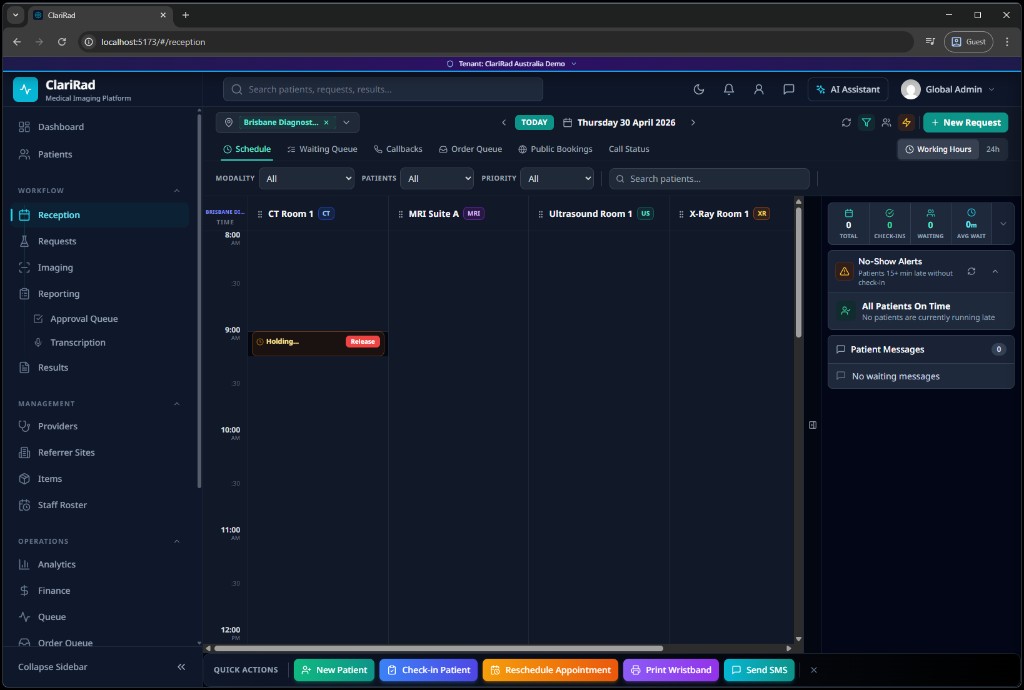
Booking and scheduling
ClariRad RIS centers the appointment and resource narrative so front desk, modalities, and downstream billing steps share one source of truth.
Central scheduling
Appointment creation, edits, and cancellations propagate consistently across sites and rooms so modality calendars and reporting queues stay aligned.
Referrer and patient touchpoints
Structured paths for referrals, recalls, and notifications—scoped per engagement—so bookings reflect clinical intent without duplicate keying.
Modality alignment
Scheduling decisions tied to modality worklist behaviour so technologists see coherent study context from booking through acquisition.
Reporting workflows
Reporting in ClariRad RIS is treated as a lifecycle—from draft through verification, distribution, amendments, and audit—not a disconnected document drop.
Report lifecycle
Statuses and routing support accountable handoffs between dictation, transcription where used, verification, and release—visibility without shadow spreadsheets.
Distribution and communication
Controlled paths for delivering reports and notifications to referrers and patients within your compliance boundaries.
Corrections and addenda
Structured handling for amendments so subsequent readers see the authoritative record rather than orphaned copies.
Billing and administration support
Administrative workloads shrink when billing-adjacent data originates from the same workflow as bookings and reporting—still scoped to your claiming model and finance rules.
Billing-ready workflow
Study and patient context feeds billing preparation steps without re-keying between clinical and finance teams—interfaces to practice billing systems confirmed per engagement.
Day-to-day administration
Fewer swivel-chair reconciliations across schedulers, managers, and finance when operational records stay coherent from booking through invoice-ready outputs.
Operational reporting
Management views over throughput, modality utilisation, and workflow bottlenecks grounded in platform data rather than manual roll-ups.
Integrations and connected systems
Integration scope is confirmed per engagement; Trucell maps message flows, ownership at interface boundaries, and test evidence so ClariRad RIS does not become the brittle centre of a spaghetti diagram.
PACS and imaging archives
Study identifiers and workflow continuity between ClariRad RIS scheduling, reporting, and your imaging archive and diagnostic viewers.
Modalities and worklist
Worklist and modality behaviour aligned with how bookings are created and amended so technical floors match front-desk reality.
Orders and messaging
HL7 or equivalent pathways where required—referrer systems, order feeds, ADT-style updates—validated against your network and security model.
Identity and access
Alignment with your directory or SSO context where scoped so clinical and admin roles see appropriate surfaces—without weakening segregation expectations.
Billing and practice systems
Outbound feeds or integrations toward finance and claiming stacks agreed in writing; cutover test packs reduce surprises after go-live.
Referrer collaboration
Channels for report delivery and notifications matched to referrer preferences and privacy obligations—not one-size-fits-all assumptions.
Migration and delivery structure
Phases flex with estate complexity; the backbone below reflects how Trucell typically runs ClariRad RIS programmes in Australia—including deliberate migration windows.
Fit and workflow discovery
Sites, specialties, billing model, referrer patterns, PACS context, and legacy RIS data characteristics captured to shape configuration and migration risk.
Technical and integration baseline
Identity, connectivity, backup, monitoring, and integration checkpoints agreed with IT and imaging leadership before build-heavy work lands.
Migrate, configure, validate
Historical and in-flight record migration paths, structured test windows, parallel running where appropriate, and sign-off criteria before clinical dependence shifts.
Go-live and steady-state support
Hypercare, tuned escalation paths, and improvement hooks tied to Trucell support—same vendor thread from database through application.
Support after go-live
Application incidents rarely respect office hours; ClariRad RIS support is structured so imaging operations know who owns the problem across layers Trucell manages.
Named escalation
Escalation paths into teams that know ClariRad RIS configuration—not anonymous queues disconnected from your estate.
Stack-aware response
When Trucell operates network, backup, or security services for you, incidents can be triaged without bouncing between an MSP and an offshore app desk.
Hypercare and tuning
Post go-live attention windows and backlog grooming so fixes and small enhancements land on a predictable cadence.
Governance, privacy, and assurance
ClariRad RIS programmes are planned so accreditation, privacy, and board conversations trace back to operationally defensible evidence—not aspirational policy decks.
Audit and traceability
Workflow actions and report lifecycle events anchored in the platform to support internal QA and external scrutiny.
Access and segregation
Role-appropriate access aligned to least-privilege intent; design workshops surface who should see booking, clinical, and billing surfaces.
Operational artefacts
Trucell aligns delivery documentation with how we run ISO-governed operations—so your file packs reflect lived practice, not template filler.
Expected outcomes—and why vendor ownership matters
You should expect fewer operational seams between scheduling, clinical reporting, billing-adjacent steps, and communication—and faster resolution when something needs a code or configuration change in ClariRad RIS.
Outcomes clients target
- One accountable workflow narrative from booking through billing-adjacent steps.
- Clear Australian support and product relationship for core imaging operations.
- Roadmap and remediation conversations with the vendor that also ran implementation and, where engaged, your infrastructure.
Risks when RIS programmes lack ownership clarity
- Reseller-only models where the vendor and implementer blame each other under pressure.
- Under-scoped integration: go-live happens but modalities, PACS, or billing reality force expensive rework.
- Underestimating day-two: incidents need both application and infrastructure fluency—Trucell brings both when you engage us across the stack.
Send a quick scope brief
Share your context and timeline for ClariRad RIS. We will reply with a practical next-step recommendation.
Frequently asked questions
Common planning questions for ClariRad RIS.
What problem does ClariRad RIS solve?
It consolidates scheduling, reporting lifecycle, billing-related workflow, and referrer communication for Australian imaging organisations that want cloud-operated RIS without juggling disconnected admin tools—and it is backed by Trucell as manufacturer and implementer of ClariRad RIS.
Who is ClariRad RIS for?
Radiology and imaging groups in Australia that need modern RIS capability, clearer audit trails across the imaging pathway, and a single vendor accountable for ClariRad RIS and delivery—not a patchwork of imported tools with fragmented support.
How does migration from a legacy RIS work?
Discovery captures sites, data volumes, and integration dependencies first. Migration windows, parallel running where appropriate, validation packs, and cutover criteria are agreed before clinical dependence moves—so modalities and billing stacks are not surprised mid-switch.
What support is included?
Support is structured around Trucell’s ownership of ClariRad RIS: named escalation paths, Australian delivery context, and alignment with Trucell managed IT, backup, and security services when you engage us for the broader estate.
How does ClariRad RIS relate to PACS and modalities?
Implementation plans explicitly cover PACS and modality integration, worklist behaviour, and validation—scoped per your environment so ClariRad RIS scheduling, imaging, and reporting stay coherent end to end.
How does ClariRad RIS support governance reviews?
Workflow and reporting lifecycle data lives in the platform narrative—supporting traceability for QA and accreditation conversations—paired with Trucell’s documented operating model when you need assurance depth beyond the application alone.
Services that deliver this solution
Trucell service lines that scope, implement, and run the work behind this solution—with ownership and evidence your teams can trace through procurement and assurance reviews.
-
PACS & RIS
Radiology IT for imaging providers: uptime, image access, reporting workflows, modality and DICOM integration, PACS and RIS, storage, diagnostic displays, clinical kiosks, privacy, and vendor coordination—managed with one escalation path, not generic MSP defaults.
Read more -
IT support
Managed support with HaloPSA, NinjaOne, Zabbix, and NetApp-aware runbooks: one accountable story for the desk, endpoints, monitoring, and backup, with regional coverage including the Philippines, Australia, and Chile, ISO- and ITSM-governed delivery, and an honest RFP scorecard (SLAs, E8, and references).
Read more -
Cloud
VPS, private cloud, NextDC and Equinix colocation (rack spaces, private cages, private suites), cloud access, connectivity, international networks, peering, high performance computing, remote hands, and Azure (AMMP): one accountable path from facility to stack, identity, backup, and IT support, with governance you can file and an RFP scorecard you can test.
Read more -
Strategic managed service
Board-to-desk IT strategy for organisations: TAM rhythm, defensible QBRs and panels, vCIO or vCTO depth, roadmaps that match budget and run-state, and co-managed IT with one queue.
Read more